Pigeons nesting under your panels do not just make a mess — they rot the underlayment, block drainage and chew wiring. We clean it out and seal the array with PVC-coated galvanized steel, backed by a 10-Year No-Bird Guarantee.
We respond within 1 business hour.
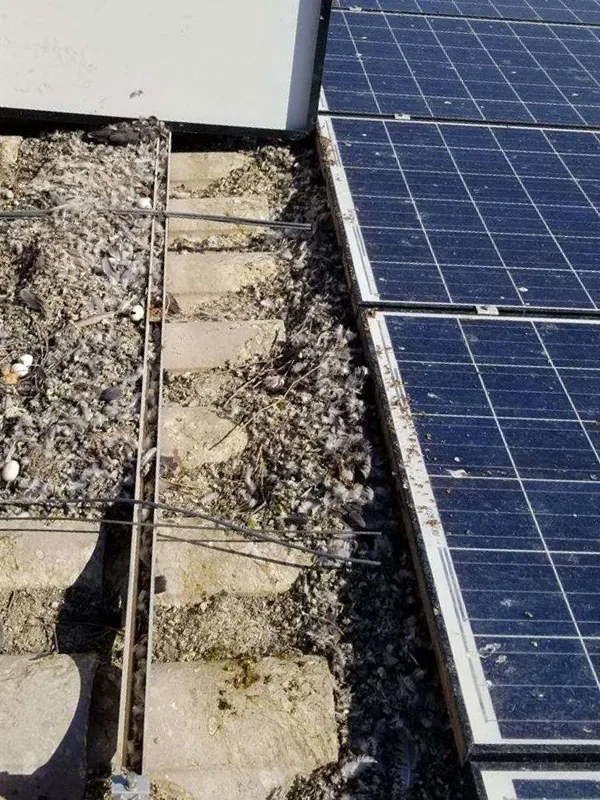
The gap between a solar panel and an Arizona roof is close to a perfect nesting site. It is permanently shaded in a climate where shade is scarce, it holds warmth through the night, it is sheltered from monsoon wind and driving rain, and it is almost completely inaccessible to hawks, cats and anything else that would otherwise move a bird along.
Arizona's rock pigeons do not migrate. A pair that settles under your array in spring is still there the next year, and their young return to nest in the same place. That is why this problem never resolves on its own, and why it accelerates — what starts as one pair becomes a colony in two or three seasons.
By the time most homeowners call us, the nest has been there long enough that the question is no longer whether to clear it out, but whether the roof underneath still needs work as well.
Four separate problems, and the expensive one is the roof.
Bird droppings are acidic. Held against tile underlayment by damp nesting material, they break it down — and underlayment is the layer actually keeping water out of your house. This is the damage that turns a cleanout into a re-roof.
Accumulated droppings carry disease and support mite populations that migrate along wiring and into attic spaces. It is directly above where you live, and it is not a mess you should clear yourself.
Droppings on the glass and along the lower edge of the modules shade cells and cut output. Gradual unexplained production loss on an Arizona system is very often birds rather than equipment.
Nesting material traps moisture against conduit and connectors, and birds pull at accessible cable. We find chewed and corroded DC wiring under heavily nested arrays more often than most homeowners expect.
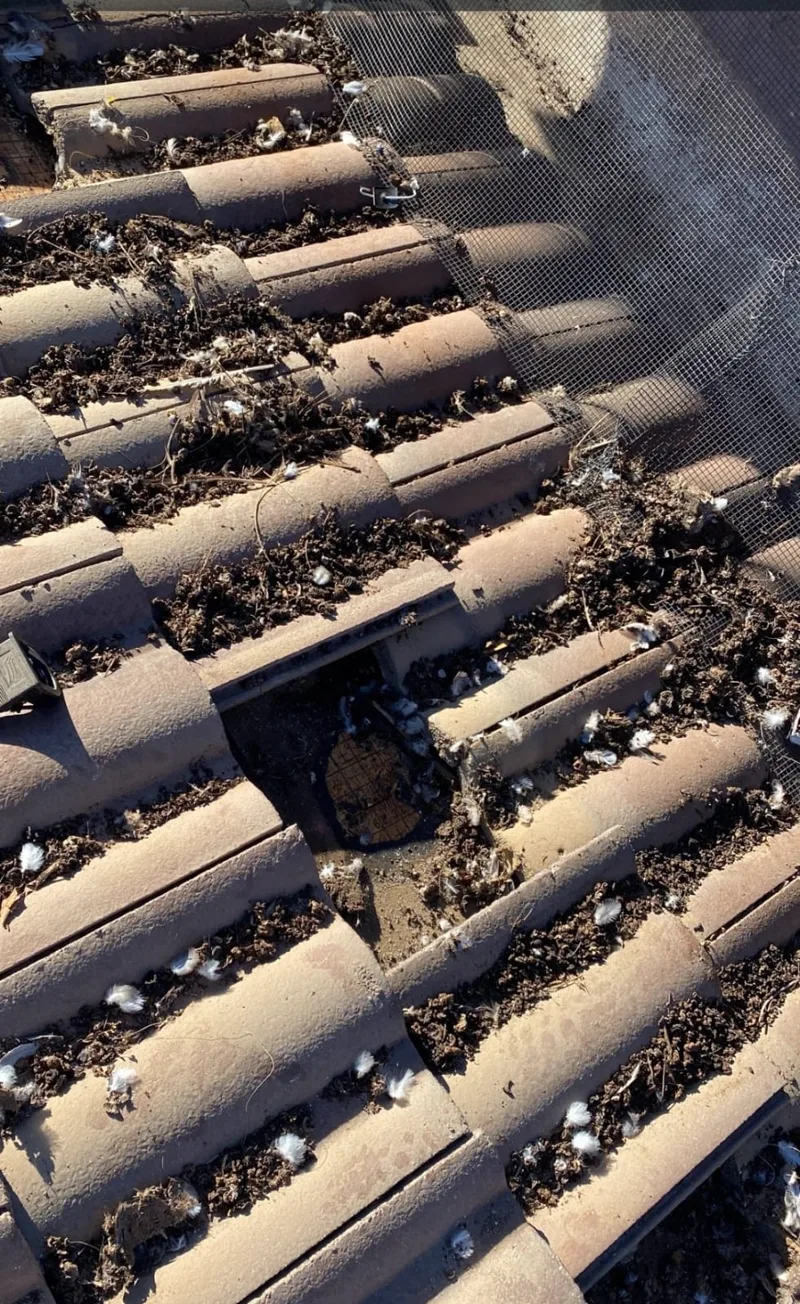
Most homeowners call us about noise or mess. What we are actually looking for is what the nesting has done to the roof underneath, because that determines whether this is a straightforward cleanout or a much larger conversation with your roofer.
Damp nesting material sits directly against tile and underlayment for months at a time. Add acidic droppings and Arizona heat cycling, and the underlayment — the layer actually keeping water out of your house — starts to break down. Tiles crack under the weight of birds and debris, and once one is broken the gap only gets larger.
Because we are a licensed contractor working on roofs every day — not a pest company that also touches solar — we document what we find and tell you plainly whether the roof needs attention before any guard goes on. If it does, we coordinate directly with your roofer.
PVC-coated galvanized steel mesh, colour-matched to your panel frames. The coating is the part that matters in Arizona: bare galvanised wire eventually rusts and streaks down a roof, and plastic mesh becomes brittle and fails under UV within a few seasons. PVC-coated steel does neither, which is why we can guarantee it for ten years.
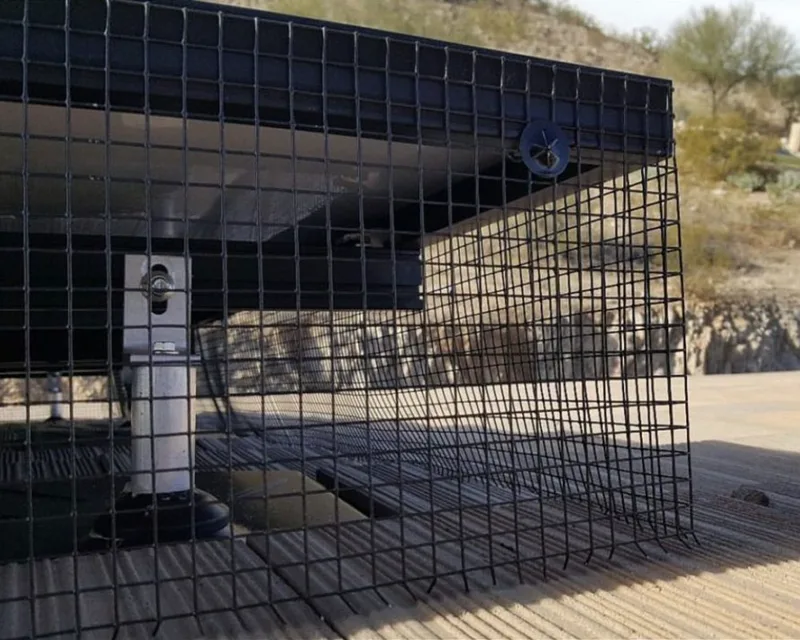
Cleaning out a nest without installing a barrier buys you a season at most. The birds return, because the site is still ideal and they know where it is.
Installing a guard without cleaning out first is the genuinely bad outcome. It seals droppings, nesting material, mites and sometimes live birds against your roof, where none of it can be reached without removing the guard again. We will not do it, and it is worth asking any other company directly whether they will.
The sequence is always the same: remove the nesting material, clear and wash down the affected area, allow it to dry, then install the mesh around the full perimeter.
If birds get back under your array within ten years of our installation, we return, remove them and repair the guard at no charge.
It is a longer commitment than anyone else in Arizona offers on this work, and we can make it because of what we install and the order we do it in. The one thing it does not cover is another contractor removing a section of mesh while working on your roof — if that happens, call us and we will re-secure it.
Most homeowners notice the noise first — cooing and scratching directly overhead, loudest at dawn. By the time you can hear it, the nest is usually well established. Other signs worth checking:
If you are seeing any of these, the useful thing to know is that the cost only moves in one direction. A cleanout and guard on a lightly nested array is straightforward work. The same array left two more seasons can mean underlayment repair, and that is a roofing job.
There are cheaper deterrents, and they are worth understanding before you spend money on them.
Spikes are designed to stop birds landing on a flat ledge. They do nothing about the gap under a solar panel, because the bird is not landing on the spikes — it is walking in from the side. On tile they also sit proud of the surface and collect debris.
Repellent gels and sprays break down in Arizona sun within a season or two and have to be reapplied. They also create no barrier: a nesting pair will tolerate a deterrent to keep a site this good.
Plastic and nylon netting is the closest alternative, and it is what fails most often. UV makes it brittle, it sags, and once there is a single tear the birds are back in — usually somewhere you cannot see from the ground.
A rigid, UV-stable, mechanically fastened barrier around the full perimeter is the only approach we have found still working a decade later. That is precisely why we can guarantee it for ten years.
Most residential bird guard jobs are finished in a single visit.
“They did a great job detaching and resetting the solar panels. Replaced the bird guard and filled unnecessary holes in the roof to ensure there will be no leaks. If you have solar and are getting your roof replaced, Solar Detach and Reset is the company to choose.”
Nesting damage often shows up first as lost production or a fault. We diagnose and repair the electrical side.
Re-roofing? Panels come off anyway — the cheapest time to clean out and guard an array is while it is already down.
If nesting has reached the underlayment, we coordinate the whole job with your roofer.
How pigeon barriers work, what installation involves, and when a cleanout has to come first.
What Arizona storm season does to arrays and roofs, and the checks worth doing before July.
Shade, warmth, predator cover — and the fix that actually holds.
Done wrong it is worse than none. What correct looks like.